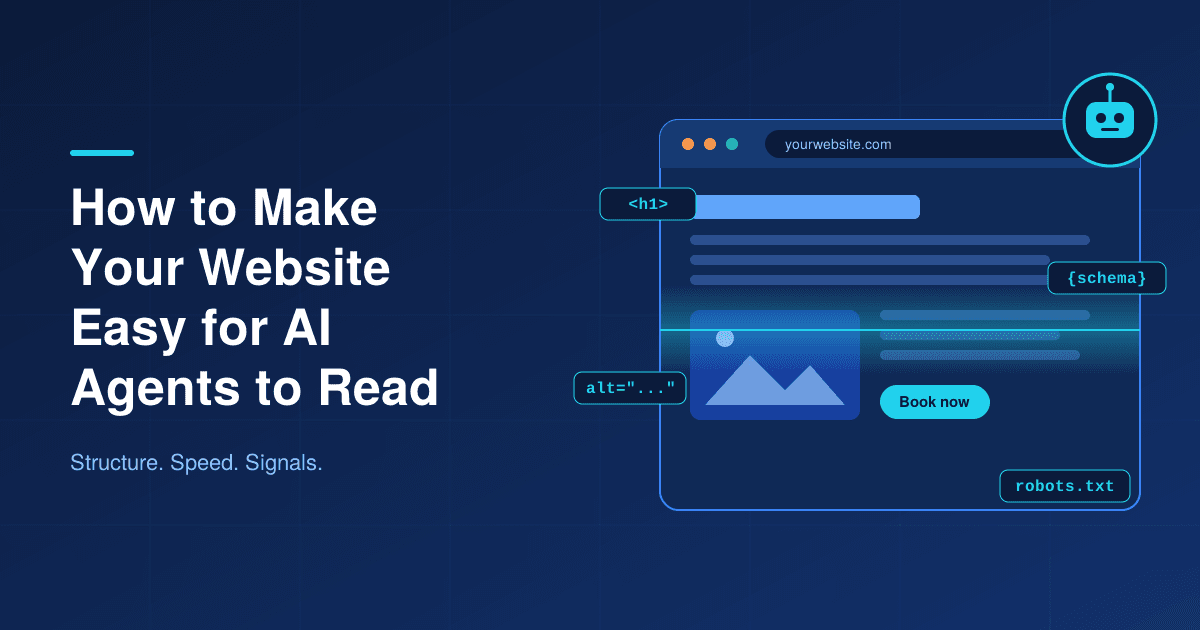
Making your website easy to read for AI agents starts with structure, speed, and clear signals.
How to Make Your Website Easy for AI Agents to Read
For years, websites have been built for two audiences: people and search engine crawlers. A third audience is now showing up in force. AI agents browse, compare, and act on behalf of users, and they read your site very differently than a person does.
On Cloudflare’s most recent earnings call, CEO Matthew Prince described helping customers attract more agent traffic as “sort of the new version of SEO.” He also noted that customers are split. Some want as many agents as possible, while others see them as a threat and want them kept out. Either way, you now need a deliberate strategy. This guide covers how to make your site easy for AI agents to read.
Key Takeaways
AI agent optimization is shaping up to be the next evolution of SEO, and sites that make themselves easy to find and read will be better positioned to benefit.
Content signals and bot management let you decide which agents get access and how your content can be used.
Speed, structure, and accessibility help agents and humans alike, and you can check your progress with Cloudflare’s tool.
Make Your Site Easy to Find and Access
Improve discoverability. An agent can only use what it can find. Keep your sitemap current, use clear internal linking, and make sure important pages aren’t buried or blocked by accident. Freshness matters too. Prince explained that Cloudflare gives OpenAI signals about when a page has changed, so its crawler doesn’t have to keep re-fetching the same content. Agents favor sources that are easy to crawl efficiently, so accurate update signals work in your favor.
Implement content signals. Not every site wants every agent. Content signals let you state how bots may use your content, so you can welcome some uses and restrict others rather than choosing between fully open and fully blocked. This matters because agent traffic carries real costs. Prince described an agent choosing a restaurant that might pull menus from 1,000 sites, while the user visits only one. The other 999 sites bear the cost with no benefit. Setting clear rules helps you decide which visits are worth supporting.
Optimize for Core Web Vitals. Core Web Vitals measure loading speed, interactivity, and visual stability. They were designed with human visitors in mind, but a fast, stable site is also easier for automated visitors to load and read. Slow pages and layout shifts create friction for any visitor. Prince has said he expects nonhuman traffic to grow dramatically, so a performant site is better equipped to handle that volume.
Make Your Site Easy to Understand and Use
Add structured data and optimize the accessibility tree. Structured data, such as schema markup, labels your content in a machine-readable format. It tells an agent that a number is a price, a block of text is a review, or a date is an event, rather than leaving it to guess. The accessibility tree is the simplified version of your page that browsers build for assistive technologies like screen readers. Agents can read it too. Use semantic HTML, descriptive labels for buttons and form fields, proper heading order, and meaningful alt text. A site that works well for people using assistive tools is typically easier for agents to navigate.
Support Web MCP. Reading a page is only the first step. Agents increasingly need to take actions, like searching a catalog, checking availability, or starting a booking. Web MCP lets a site expose its tools through the browser, so an agent can use those functions directly instead of guessing how to click through the interface. It is still an emerging area, but it points to where agent-friendly websites are headed: sites that offer clear, structured ways to do things, not just pages to read.
Test your agent readiness. Once these pieces are in place, run your site through Cloudflare’s isitagentready.com tool to see how it measures up. Treat the results as a to-do list, fix the gaps, and test again.
Conclusion
Making your website easy for AI agents to read doesn’t require starting over. It builds on practices many teams already follow: clear structure, fast performance, accessible design, and sensible rules for who can access your content. The difference is that your visitors now include software acting on behalf of real people, and some of those visitors may soon pay for access or receive discounts for explaining why they are there.
Start with discoverability and content signals, then work through performance, structured data, accessibility, and Web MCP.
As with early SEO, the sites that prepare now will have the advantage.