
Google offers tips on managing a website’s crawl budget.
Is Your Crawl Budget Holding Back Your SEO and AI Search Visibility?
If search engines can't efficiently crawl your site, your best content may never be discovered, indexed, or surfaced in results, including AI-powered search experiences. Crawl budget is often treated as a concern only for enormous websites, but the way crawlers spend their time on your site says a lot about its overall health. Understanding what drains that budget, and what protects it, helps ensure your most valuable pages get the attention they deserve.
Key Takeaways
Crawl budget is made up of two parts, crawl rate limit and crawl demand, and is driven by site quality, how often your URLs change, and how popular they are on the internet.
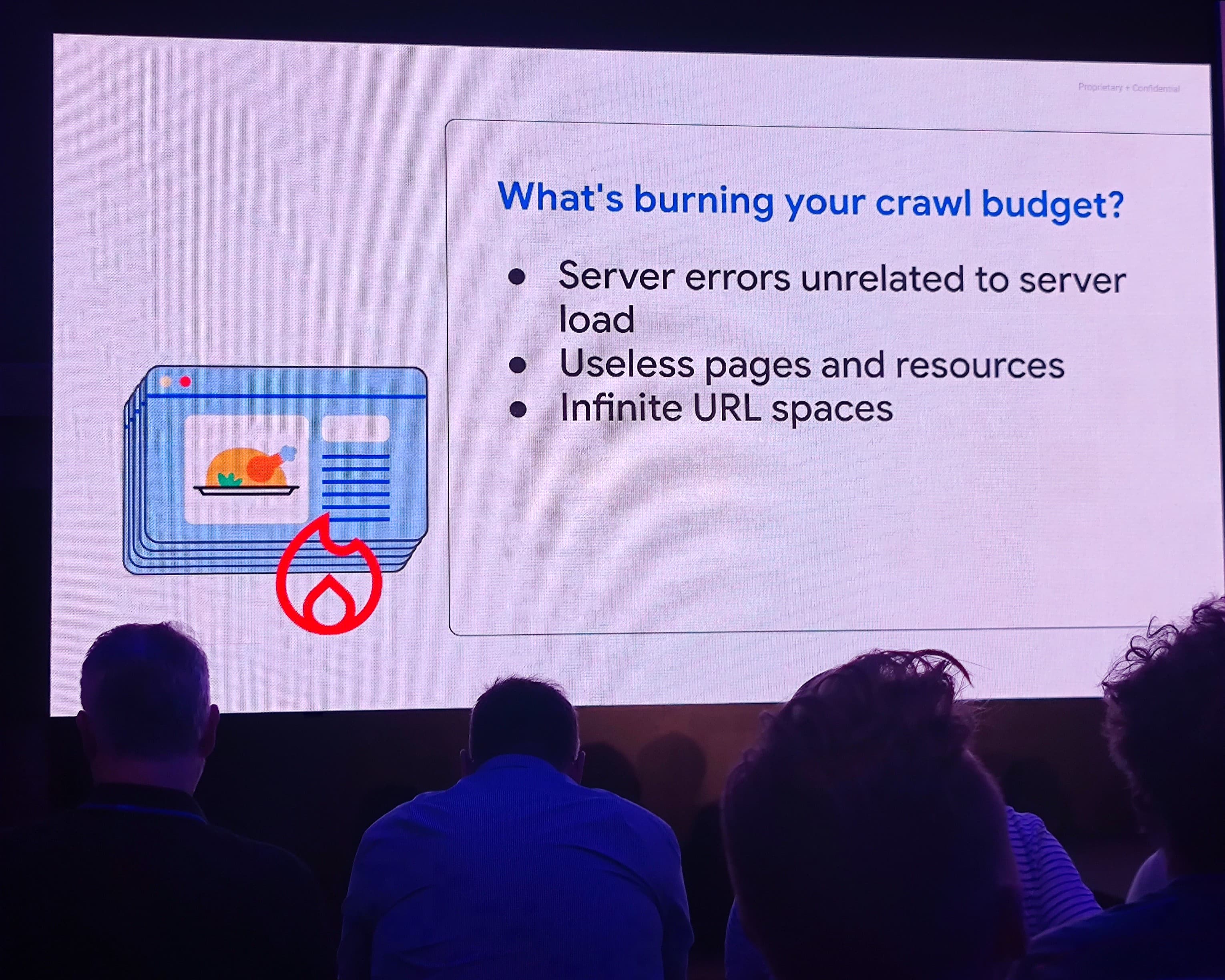
Server errors, useless pages and resources, and infinite URL spaces are the biggest drains on your crawl budget.
Not every directive treats crawl budget the same way: robots.txt disallow rules don't consume it, while noindex rules do.
What Crawl Budget Is and What Burns It
Crawl budget is the combination of crawl rate limit and crawl demand. Crawl demand is shaped by three factors: the quality of your site, the change frequency of your URLs, and their popularity on the internet. When quality or popularity is unknown for a given URL, the aggregate quality or popularity of the parent root is used instead, then that path's parent, and so on up the chain. In practice, this means weak sections of your site can drag down how a crawler views the pages beneath them.
Three common culprits burn through crawl budget:
Server errors unrelated to server load. Errors that aren't tied to real traffic strain fail to serve users or crawlers and waste crawling effort.
Useless pages and resources. Pages that offer little value still get crawled, taking time away from the content that matters.
Infinite URL spaces. Structures that can generate endless URL variations give crawlers a nearly bottomless pit to explore.
HTTP status codes also affect how your budget is spent:
1xx (informational): Doesn't affect crawl budget.
2xx (success): Consumes crawl budget.
3xx (redirect): Consumes crawl budget per "hop," so long redirect chains add up.
4xx (client error): Not indexable, but doesn't affect crawl budget. The exceptions are 429 and soft 404s. A soft 404 affects crawl budget like a 200 does.
5xx (server error) and 429: Cannot be indexed, slows down crawling, and consumes crawl budget.
The takeaway is that a clean, reliable server response is one of the simplest ways to keep your crawl budget working for you.
How to Manage Your Crawl Budget
Managing crawl budget comes down to four practical steps:
Ensure that you use HTTP cache control. Proper caching helps crawlers avoid re-fetching content that hasn't changed.
Ensure your site has good navigation. Clear navigation helps crawlers reach your important pages efficiently.
Restrict crawlers' access to faceted navigation and general action URLs. These are frequent sources of near-endless URL combinations.
Improve or remove useless content from your site. Cutting or upgrading low-value pages keeps crawling focused on what counts.
It's also important to choose the right tool for the job, because directives don't all behave the same way:
robots.txt: URLs disallowed through robots.txt don't affect crawl budget.
noindex: A noindex rule consumes crawl budget, because the page still has to be crawled for the rule to be seen.
nofollow: A nofollow rule can consume crawl budget.
crawl-delay: This non-standard robots.txt rule is not processed by Googlebot, so it is not a way to control how Google crawls your site.
A common mistake is reaching for noindex to keep low-value pages out of the way. Because those pages still consume crawl budget, blocking them through robots.txt is often the better choice when the goal is to protect it. Just keep in mind that the two serve different purposes, so the right choice depends on what you want to achieve with each set of URLs.
Conclusion
Crawl budget isn't just a technical footnote. It influences how efficiently search engines find, process, and index your content, and content that isn't indexed can't show up in search results, including the AI-driven search experiences that increasingly shape how people find information.
By keeping your server healthy, cutting useless pages, taming endless URL spaces, and using the right directives, you help crawlers focus on the content that matters most. Start by auditing your status codes and URL structures, and you may find that a few targeted fixes go a long way toward improving your visibility.